4.07.2011

Digital Painting... It's Art, Dang It!!!

Coming up to my last year at Brock, I've been hunting around for "practical" courses to add on to my more academic pursuits at university, in the hopes of landing a position within the next few years with a game-design company.
One of the skills I was hoping to develop was that of my artistic abilities.
I have a background in traditional art (starting from early childhood involving the side of a bookcase and an unattended tube of lipstick), and I've been trying hard to get better at it on my own time for many years - taking as many art-related courses as possible while in school in the hopes of gaining further instruction on how to improve.
At university, however, I made the mistake of assuming I would be able to continue that pursuit as thoroughly as I would have liked...
Granted, my program allows for a certain amount of freedom in being heavily cross-listed (which lets me sneak into things like Visual Arts courses), but it seems that the majority is focused on the programing aspect of video game design over the artistic and conceptual aspects... And for free time-practice?
No.
Just no.

So, I reasoned, when I had gone as far as I wished with university, I would go on to pursue artistic and conceptually-based college courses to compliment my theory and academic education.
Sound like a fairly good plan, yes?
There has, however, been a... hiccup.
One skill that is absolutely vial for those who want to pursue conceptual design for video games is that of Digital Painting. If one researches concept art online, a large proportion of the finished projects used in the development of models and levels are completed (if not entirely composed) with virtual tools, ie. they're digital paintings. Logically, I thought, I should pursue instruction in that venue through a college in good standing and develop my skills to a more competitive level... I have, as of yet, been unsuccessful in finding an institution that supports this medium for more than a short period in a larger class.
Why, I wonder, is that?
Digital painting (in the right hands) produces industry grade results... it's quick and nowhere near as messy or costly as the majority of traditional mediums... and takes roughly the same amount of time to complete (barring oils, which take forever to dry).
I seems to me, that this absence of professional/academic instruction may be the result of several factors.

The most irritating of them is the bias I see in the comments of many traditional artists concerning the digital medium. In pursuing a digitally-based career, it has been more and more evident to me that the vast majority of the population doesn't really understand that computers - despite their appearance of having a mind of their own, or the ability to perform almost magical functions with the press of a single button... are machines that run off of programs... and as a first-year programing professor once told the bleary-eyed throng assembled in his 8am class:
"Computers are like any other tool. They're stupid. They only do what you tell them to."
So through that logic, digital painting is quite difficult, because the program won't do anything remotely useful unless told explicitly by the user - much the same may be said of a paint brush or pencil.
The skill and knowledge of the one wielding the tool is what determines (most) of the works value
Digital Painting is, by no means simple or easy... in some ways, the tools used (i.e. the computers and tablets required to create the work) are more complicated and difficult to learn - and so, Digital Painting is easily something worthy of serious instruction.

Thankfully, I'm not alone in this particular thought process, and over the last 6 years or so, I've noticed a trend of people endeavoring to share their experience, knowledge and techniques with the general public. In posting videos, website content, selling books and many other modes of instruction, I found that there were resources available, where those that had gone before me and had made progress and discovered ways to achieve proficiency with the medium of Digital Painting all on their own after years and years.

So, while the internet community sees and understands the value of Digital Painting as a means of competing in the ever-fierce arena of the art world, even if academic institutions, (for the most part) haven't yet.

Below  is a list of links to sites that people have constructed and spent time developing to share their knowledge:
here
tutorial

4.06.2011

Minecraft... Creepers go Boom!


My new discovery for "pick up and drop" games seems to be the rapidly expanding game of ...

MINECRAFT

This game in and of itself is fascinating, especially to an IASC major, because it breaks a number of "popular game conventions" and formulates gameplay primarily around exploration and creation, rather than "kill the orc, get the treasure", gameplay we see more commonly.

Yes, Minecraft is my new addiction as of late and it seems that I'm not the only one...

The game itself is a sandbox in its purest form - a world designed and based entirely on the ludic attitude of the player - they must make their own story.
The story (or premise in this case) of Minecraft is as simple a thing as one can imagine:

"One day you were dropped in the middle of nowhere. Go."

At least that's what a new player with no prior knowledge will deduce from their surroundings.


              Apart from being a great deal of fun, Minecraft is a world in which the player is able to literally reshape the terrain as they see fit, manipulating the area to form homes for themselves to provide protection from hostile creatures that spawn in the environment, make farms to collect resources more efficiently, forges and work tables to make tools, food, objects to use in construction, etc.


The world is infinite (topographically, though one is limited to a certain height above ground, and depth below.
Game much more than consumption and entertainment - it literally acts as a vehicle for dialogue between player, developer, and game environment with which a story is formed through exploration, consumption and maintaining of resources available (through farming and planting trees, etc.).
 Break anything. Build anything. Collect anything except for Bedrock, Clouds, and the Sun... The versatility of play in this visually-simple game is tremendous, and  accommodates all kinds of play, emulating a progression from "hunter gatherer" behavior to that of farming, and even industry if the player chooses to do so.


Personally, I, like many others, enjoy the construction aspect the most, devoting a great deal of time to the collection and assembly of materials into defense, and then far more time just building things to ammuse myself (images shown below were built by other Minecrafters!).


Minecraft is so versatile in fact, that a Minecraft Wiki was developed by users to sort out what can and cannot be done within the game (without modding it), introductory information and advice to new-comers, and many, many pages of information on details concerning nearly every aspect of the game as it is, and speculations/plans to prepare for what it may be as the game continues to update regularly.


A community of gamers has formed around this strange little game, and continues to grow at a tremendous rate.


I find this trend very, very encouraging.

Too often do I see game upon game released with the same "story", the same premise, and the same basic gameplay as its innumerable predecessors and Minecraft is a refreshing break from that monotony.

Long-live the Indie Developer!

4.05.2011

Art Show!!!


Yesterday was a first for me:
I actually presented my artwork in a public show...

It was a strange and fairly positive experience for me, having only ever shown my work in school to instructors and classmates.

It was also fascinating watching/participating in a student art-show as an artist and not a viewer.
Before the first people arrived, I strolled around like I had in past classes, looking at everyone's work, comparing it against what I thought could do and what I had done, talking to my classmates about their work and my own, and so on.

But then the first visitors came, and the crowds began to grow, and I felt myself getting nervous.
Would they like what I and m partners had made?
Was it original enough to be interesting but not so different that the meaning would be lost?

In all honesty, I was expecting a less-enthusiastic reception for the public than what we received. Multimedia was a strong factor in our show and  in my experience at least, that sort of thing is rarely well received by the public where student work was concerned.
Things seem to have changed, however...
My group's piece which was one of several combined media of sculpture, projection and architectural models was well received. Perhaps society has become so used to multi-media extending through rapidly evolving technology into every facet of our lives that heavily "multi-media-centered" works are more palatable  - less alien and controversial than it might have been 10 or 20 years ago. It seemed to me that a number of the people attending weren't people that would customarily come out to a formal gallery - curiosity seemed to draw them in. So we found ourselves surrounded by "art-people" and "non-art-people"... and it didn't matter.
The ones that came in off the street out of curiosity mingled with the "academic" art people almost seamlessly... some paused to consider particular works for a while, others moved on with barely a glance. There seemed to be no difference between the reception of either crowd.
This experience has served to reaffirm my opinion that the days of the elitist art- crowd are fading - thanks to the web, art and appreciation of it is possible outside of traditional venues of "higher education" - one can educate themselves as much or as little as they like. The boundary between educated and not is rapidly shrinking, and it truly makes me happy to think that within a short time, people will begin to look at art in a more natural, less structured way, and likely, enjoy it all the more.

3.28.2011

arena for social change

Okay, this one should be short and fairly sweet...


In the early days, it was generally argued that video games were nothing more than a means of entertainment and one could generally be hard-pressed to argue it to the contrary.
Now, as games continue to evolve and mature as a medium, we see aspects of social commentary beginning to seep into them. One that we find is that of sexual orientation and human rights.
BioWare is one of the leading companies in the field that strive to break conventions, not only in the history of  video games, but social mainstream media.


BioWare's latest title, Dragon Age II features a variety of playable races, genders and a large variety of NPCs that are available to include in the player's team. A few of these characters are options for romance-paths of the main story, and that includes same-sex relationships.


Rather surprisingly, this caused problems in some areas of the gaming community who felt that their gaming experience was being thrown off by the inclusion of a possible (but not mandatory) homosexual relationship between their player character and an NPC.

There was an article (found here), about one such person, calling himself "Straight Male Gamer", postedon the BioWare blog for the game complaining about this issue... and royaly making a fool of himself in the process.

The lead writer for Dragon Age 2, David Gaider posted a personal response to the less than intelligent rant put forward by Straight Male Gamer on the forum in response, calmly and intelligently not only the choice of including the possibility of same-sex romances for the player, but the need to cater to all  of the gaming community, regardless of gender, sex or sexual preference.

I cheered, I'll admit, when I read about it, and despite the fact that I'm not a fan of the Dragon Age series ( I find I dislike the turn-based combat... it's too slow), I readily applaud both BioWare's ability to defend their medium as an artform capable of real-world commentary, and their willingness to do so in within the scope of a major AAA title.

This gives me hope that video games are able to support the kind of life-changing capability I hope to achieve through them myself as a would-be developer. It's too much to hope that I could change the world with a game, but perhaps, if the game development community continues to produce titles that incorporate and explore as many assets of humanity, society and culture as they can, perhaps that can help in making the world a little better, one save game at a time...

3.27.2011

War of theWorlds vs. Invasion of the Body Snatchers vs. Mass Media...


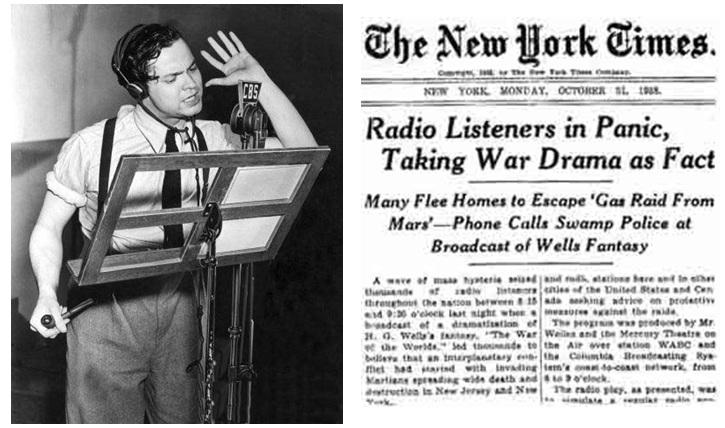
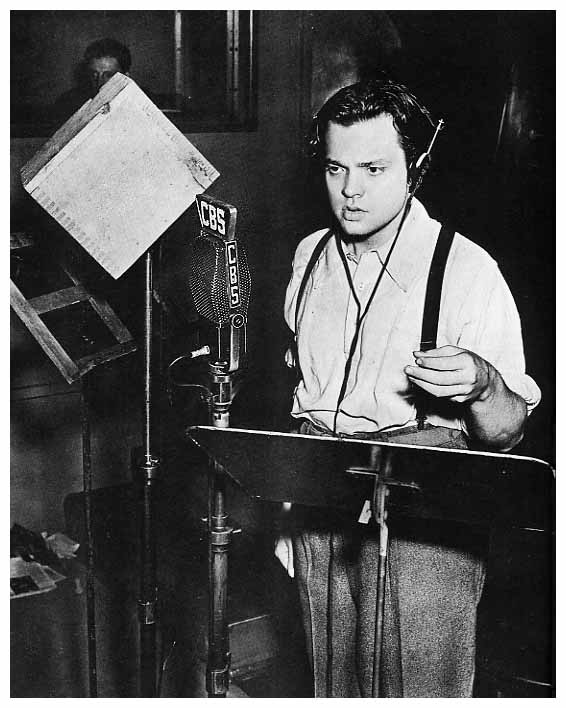
We all know the story of how  Orson Welles and others preformed a radio play of War of the Worlds - Orson Welles Broadcast in 1938, and (perhaps) inadvertently caused panic, confusion and a certain amount of chaos across a fairly large area because many people believed that the broadcast was not, in fact, theatrical, but live news coverage of an actual event. My brother told me that the same thing had occured years later in Ecuador, 1949, where a Spanish-speaking radio station mimicked Welles' performance and cooperated with a local newspaper that had published stories weeks before about UFO sitings in the area. The public believed, the public panicked, and when they realized the nature of the deception, they rioted and attacked those in the radio station and newspaper that had participated in the hoax.

My brother brought this up in a conversation we were having a few nights ago, and then he asked me...
"What if Invasion of the Body Snatchers was read by Orson Welles over the radio in 1938 instead of War of the Worlds?"
The answer we both came up with:
"People would be shooting people instead of water towers..."

Bummer.


But seriously, what does that tell us about the impact that media has on people's perceptions of reality? They believed it because it was on the radio... then people believed it because they saw it in a movie... then because they saw it on TV... and now they believe it because they saw it on the Internet.
I find that the willingness of many people to accept what they're shown through popular media as "Truth" is vaguely alarming. On the whole, this blind faith is fairly harmless when taken in the context of entertainment - a well-staged joke or false event to make long hours in front of a computer pass by a little more smoothly... but sometimes these things can mutate into something misunderstood as "Truth" and can actually cause harm.
Gamers often catch the brunt of things like this, wherein videos meant to be entertaining jokes like Angry German Kid, WoW Freakout - Password Change, Greatest Freakout EverGreatest Freakout Ever 2 , etc. which are meant to be no more than amusing little videos based on gamer-sterotypes, are taken as genuine, serious recordings that "prove" the dangers of video game addiction. Video games, like radio, film and TV before them are often blamed for the ills of society - parents aren't failing to raise their children, it's the fault of those evil video games (that we bought them...).
Now, this isn't to say that all society's problems are caused by neglectful parents, nor are they caused by video games (or media of any form), but there is a trend that functions on a massive scale which suggests that while the general populace are not "mindlessly passive consumers", they can be convinced of an artifact's validity so long as it's presented in a format that supports it.
Films like Wag the Dog make commentary of that kind - in illustrating how easy it might be (or has been, looking at global history over the last ten years or so) for a clever few in power to generate an entire war without ever firing a shot or dropping a bomb. The public believes because they were shown events through the correct channels, or enough channels, prompting them to believe in and support a war that didn't exist.
That film, and others like it, suggest that the public can be made to believe because they, (or someone else) saw it happen... or at least they thought they did.


The power of the media is tremendous, and I think it might do all of us well to take more care in trying to diversify our sources of information to avoid that kind of thing in the future...

3.06.2011

What's With the Remakes ?!?!?!

I'm not a film major, but I do love movies...

I've always loved stories - whatever form they took, and I spent much of my very young childhood watching movies with my parents. And having been born in the early 80's, I have a particular fondness for movies from that time period.

It is likely because of this that I view the increasing flood of remakes and long-delayed sequels to these films surging out of  Hollywood to be both vaguely disturbing and depressing at the same time.

Not that I have any particular hatred for furthering a good concept, or the re-telling/imagining of a story - I liked the 2009 Star Trek.
I really did.
Why?
Because it was in the spirit of the thing - it was not "my" Classic Star Trek - not the Captain Kirk I had watched since I could sit up on my own, but it was Star Trek in spirit, and that made it fun, and a generally good film of it's kind. Not profound, but fun, and in the spirit of a "space-cowboy" adventure with a "band together and save the world" flare thrown in for good measure.


It was alright (with me, at least), because it wasn't the Star Trek I'd grown up with - nor did it pretend to be - it was even stated, rather implicitly that what we as the audience (and the characters within the film) that they were existing in an alternate universe from the one that I had grown up with.
It was something new, it was something unique in and of itself, based on a "mythology" I had known from very early childhood, and then reconstructed to make something new and enjoyable for the 2009 audience.

But then there was Tron Legacy... which was, on the surface, something like the original, with some of the original tone... but it wasn't in the spirit of the thing.

The original Tron was a film about he speed at which information travels, corporate cut-throat politics, cyber-spirituality, a fear of the technology itself and a number of other cultural, philosophical, and technological questions that were nothing short of revolutionary in its time. These ideas could only be brushed on very lightly, however, because of the time in which the film was made.

(Painting of TRON by HenryTownsend on Deviant Art)
 
In 1982, very few people had a personal computer, let alone any real understanding of the way in which this new and exciting technology worked. Video games were still struggling to return to the home market after their messy (abet temporary) death in the mid 70's, but were seeing an increase in popularity in the form of the arcade with preteen to teenage audiences. So a film that was centered around concepts and knowledge that the average person couldn't relate to would have to rely on spectacle to remain engaging to the audience as it delivered - or at least suggested at - its underlying themes. Thusly, we see Tron also as a hallmark of "cutting edge" digital and animated special effects as well as a fore-runner in fields of thought concerning the (relatively) new field of computer technology that few had attempted to explore at the time.

Because the public was far from "technologically literate" where computers and video games were concerned, the ability of the film to really "converse" with the audience about its deeper subjects was understandably hindered, forcing us to wait until the rest of society to "catch up" to the proficiency required to really understand...


So, 28 years later, fans of the original, and those of us with an interest in video games as an art-form and viable cultural text were excited (though wary) when word came to us over the net that a new Tron was about to be released, one that seemed to have the potential and opportunity to explore those deeper subjects of cyber spirituality, the Internet as it has grown to be, and so much more.
It could, if properly executed, put Ghost in the Shell and The Matrix to shame...

But they failed - hard.


Instead of a profound, intellectual-action-packed experience was reduced to the sub-standard tripe I've increasingly taken to associating with Disney in general.

Although a number of really interesting issues ranging from computer-human "Digital DNA" structures, impartiality and freedom of information over the Internet, racial purging, questions about religion, cyber-spiritualism, etc. - they were never viewed in depth - in fact, most were only barely brushed against and would have been missed entirely by those that weren't already looking for it.

What the rest of the audience was left with was a garden-variety hyper-sexualized, male-dominated approach to technology, the Internet and "gamer-culture" that utterly failed to take advantage of those issues/subjects mentioned above.

The ideas behind cyber-spirituality, the scope and reach of the web and its impact on freedom of speech are all ideas that need to be explored, but time and time again, it seems that Hollywood and increasingly so, Disney - have displayed an almost pathological adversity to including thought-provoking content in "sci-fi" environments.

Mission Impossible, The Matrix and Inception (amongst others) have showed us that intelligent story and intense action sequences are an effective combination - not at all lacking in profit for the box offices.
So then why this pathological aversion to forwarding this trend, rather than rely only on spectacle as the primary device of modern film?

I'm sure there's a financially-viable reason for it... I refuse to believe that the majority of the populace has been reduced to mere mindless consumers of media... or that Hollywood is so utterly desperate fro writing talent that it can't find more people to write really good stories...

Perhaps we're waiting on some kind of Renaissance in Hollywood... one in which a combination of thought-provoking content will be equally as important in a film as massive explosions and strategically-placed low-angle camera shots...

I hope...

2.15.2011

Evolution at the Speed of Thought?

Recently in many of my classes, the question of "action over contemplation" has arisen and I'd like to take this opportunity to comment on it...

There seems to be a pervading idea that my generation (those born between 1980-1990 ish) are those that privileged action over contemplation - a generation that leaps before it thinks, or even looks.
I can say that this is no more true now than it was for previous generations - the reason, I believe that it appears that we are so focused on speed that we miss a great deal of what we should be paying attention to.

I would argue that it's quite the opposite.

For those of us who survive in and compete in the virtual arena of the Internet - learning to sort through the continuous barrage of information we're assaulted with is critical to our ability to function within that environment as proficiently as we do. One "skill set" that is absolutely necessary is an ability to not only comprehend, but absorb, process and execute according to what we gather - the only difference between how we and our predecessors deal with that information and how quickly we are "trained" to interact with it is simply a question of speed and efficiency. If that efficiency were compromised by the speed, we would accomplish far less, learn more slowly and be generally inferior to our parents and those that came before them.

That isn't the case, however, and our generation has continued forward into what many call the next step of human evolution - one that involves a state of mind and an advancement of the human ability to think and comprehend the abstract in a way not possible before without the aid of hallucinogenic drugs.

The ideas of "cyber-spirituality" are becoming more and more pronounced - a separation from the idea that everything we feel and see is real is slowly being proven wrong. The idea of reality as being something "insubstantial" - something that exits on multiple levels as versatile and ever-changing as our own states of consciousness...
Even the question, "What is real?" is something discussed avidly beyond the realm of the traditional philosopher.


Everywhere, we find representations of the "cyber-prophet" - those mystical few who have the knowledge to transverse the enigmatic realm of the Internet - and I have to wonder why.

Is the Internet that frightening to older generations that they dare not even investigate it? Take classes to learn how to use their computers and educate themselves on the positive and negative aspects of this "parallel" realm that so greatly influences their every-day lives?

If that's so, then their fear is born of the ignorance they accuse my generation of... an interesting problem if ever there was one...
A generation gives birth to something the majority don't understand... and then refuse to engage with it, while ostracizing the following generation for the same reasons...

2.09.2011

Remember the Old Days - Back in 1984?

Regardless of our age, we've all uttered phrases like:
"Remember the Old Days?" or "Remember back when...?" or "It's old."


And inevitably, in a group of mixed ages, someone will think "That's not that old... I remember when that came out (etc.)..."

Nostalgia is something that people of my generation appear to be experienceing earlier in life than preceding generations, and it occurred to me why that might be...
It isn't ignorance of the past (as I heard a passing professor angrily proclaim in the hall), I think it's something much more fundamental - something I could suggest might point at an evolutionary step, rather than the degradation and decay of society.

The speed of technology allows for nostalgia to occur far more quickly in younger generations than it does with the older ones - things we remember fondly from our childhood are so changed in our adult life that they no longer seem to be the same thing.

Take Super Mario Brothers, for example...

I was around to see the rebirth of console gaming, and one of the forerunners of that resurrection took the form of a portly man with a mustache who wanted to save his princess from a dragon... Classic fairytale stuff, right? Well Mario and co. were only the beginning, and as video games pulled themselves from the ashes and began to flourish far and beyond what most thought even possible, the rate at which we had our favorite heroes, villains and games replaced, revamped and re-imagined accelerated at an ever increasing pace that just barely kept up with the continuing evolution of the technology on which they were based.
Now, in my mid twenties, I'm struck with a feeling of nostalgia...
I remember loading a computer game with an 8 inch floppy and typing C:/run_wordwizard...
I remember sticky fingers on little plastic rectangles of gray and black with red buttons labeled A and B...
I remember being impressed when Sonic moved faster than the in-game camera could keep up with...
I remember being awed by the 3-d  world of Mario 64...
I remember when I began to gave trouble telling the diference between "real" game images and the computer-generated ones...
Some people suggest there's an age-limit, or at least a time-duration limit on being capable of nostalgia, but I disagree.
With the accelerated state of technological development in North American culture (and the ability of the public to access much of that technology), things "get old" faster and faster - lending toward the idea that our favorites of the present may be out-dated in as little as ten years. This doesn't deminish our love of them - perhaps it even heightens our appreciation of what went before, since it passes so much more quickly than it once did.
The argument that some make about my generation's focus on the present and future over the past is perhaps true to an extent, though what's often forgotten is the necessity of our ability to process the onslaught of information, technology and change that occur around us all the time...
But I'll rant about that later =)

2.01.2011

video games - not for telling stories

One of the problems with trying to tell stories with video games is that games are not really meant for telling stories...


This isn't to say, howver that games shouldn't, or can't have stories in them, just that they aren't supposed to tell stories... they're supposed to provide opportunity for players to develop a story of their own using the "tool" provided to them through the structure of the game and their ability to develop a dialogue with it.

Telling stories is implicit, something limited to film, radio, most drama and literature, in which the audience must sit and absorb the material - not passively by any definition - one cannot suggest that a person may sit like an empty sponge just absorbing the material they're presented with - intellectual agency is always in effect.

Games are different, however.

A game should ideally make an effort to provide the frameowrk for experience - for exploration and emotional engagement forged by a dialogue between player and digital universe. When a design team forgets that they have chosen a medium in which there is more than just the creator and the consumer - one in which the player is also an author of the experience, and may, through the course of their play, generate a story of their own that stands apart from anything that the designers had originally intended.

A "good game" is one that incorporates the ideas of narrative, choice/agency and entertainment to execute a state of immersion for the player.

Telling the player a story is the wrong thing to do.


Games like Heavy Rain are a prime example where the idea of telling a story to the player overwhelmed the aspect of play and agency that defines and separates video games from other mediums. The game is laborious in its lengthy cut-scenes, some of which run for 20 or more minutes runtime, based almost entirely on Quick Time Events... a poor gameplay choice if ever there was one.

The agency of the player is reduced rather plainly to that of a classical factory worker whose only job is to press one of 8 possible buttons appropriate to the motion they're told they want to perform.

Despite the game's ablity to perform in a graphical sense, it is much more closely akin to an interactive film or choose your own adventure book than a video game in the classical sense.

This isn't necessarily a "bad thing", but it does certainly define itself as something that is not what most gamers commonly attribute to a gaming experience, nor is it a perfect transferal of traditional narrative text.

Ideally, video games will continue to evolve and will become aware that they don't have to emulate film, literature or any other medium before them - they are a medium of their own... and the sooner the developers realize that, the better the games will be.


1.26.2011

Canadian Identity in Video Games...

        
                     It occured to me rather suddenly in class today that a number of the highly-acclaimed, "AAA Titles" that are made by Canadian game companies share a number of particular elements cholars in film have identified as trends in Canadain cinema...
The Road Movie
The Loss of Identity
Body Horror
Boarders

Titles like Elder Scrolls: Oblivion and Fallout: New Vegas (Bethesda), and Bioshock (Digital Extremes) are good examples of games that exhibit these trends...
Now, if youve played, or are familiar with these titles, you'll likely see where I'm going already, so bare with me (or feel free to skip ahead to the next post).Each of these titles involves a player character who we honestly know very little about. At most, we're given very, very rough details...
In Elder Scrolls: Oblivion, you're a prisoner in a cell. We're never told why.

In Fallout: New Vegas, you're a Courier who starts the game by being shot in the head (presumbly resulting in memory loss).
In Bioshock , you're a man on a plane, who had pictures of people (who may, or may not be your parents), which we are able to view briefly before the plane falls from the sky and into the ocean. You are the only survivor.

See the connections?

We'll look at Fallout: New Vegas as an example...
We begin the game with a video cutscene in which the player's character is shot in the head by a group of thugs led by a ma in a checkered suit. Upon waking, we are met with a kind but tired sort of fellow by the name of Doc Vollmer, who informs the player of how we had been discovered shot on the outskirts of the town, Goodsprings and brought there for treatment.
From here, the formation of the player's character and their ultimate destiny begins - physical appearance, gender, age, skills, physical and mental attributes are all determined by the player's decisions. And as the game progresses through seige, open desert and impending war, the player and their character discover the past that lead to the violent and near fatal events of the game's opening cinematic.
In short, Fallout: New Vegas is a game centered on the ideas we see so often in Canadian cinema:

Road Trip
Our adventure begins as a journey to New Vegas, over the course of which we, as players, learn and develop our character to suit the environment in which they exist,  evolving and "maturing" in that world until the completion of the game.

The Loss of Identity
The opening sequence of the game involves a litteral loss of identiy,  and we begin as a fully-grown adult who must begin from scratch.

Body Horror
We are constantly plagued by the problem of radiation poisoning, and the player is forced to carefully monitor what the character eats and how much to avoid reaching a state in which the character becomes ill, suffers health loss and (if desired), may cause mutations in the character's DNA that will result in them becoming like some of the hostile creatures found in the desert called Ghouls.


Boarders
A constant theme throughout the story of New Vegas, regardless of the path the player chooses, is the idea of invasion from other stronger forces. Whether it be from Cesar's Legion, the Powder Gangers, the Vipers, the NCR or any number of other groups all fighting for control over the limited resources found in the post-nuclear apocalypse Mojave Desert.
It's obvious that even in these seemingly alien and far-removed worlds, those same themes of Canadian identity (or lack thereof) prevail in even the new media of video games, but unlike film, seems able to reach out beyond Canada's borders to an international audience that receives it with open arms...

1.19.2011

The Modern Undead - Fad or a Sign of Something More?


Recently I've become aware of the sudden fascination much of the world has developed with the shambling undead - or zombies, if you prefer.

While the classical depiction of the zombie as some unlucky person under a mind-control spell (as seen in the 1932 film White Zombie, starring Bela Lugosi) has become nearly extinct, and the mystery-origin variety seen in the George A. Romero interpretation of the shambling undead is giving way to what can only be described as plague-zombies, which are by far the most popular variation than any other before.

 We see them appearing nearly everywhere now, ranging from parodies of classic literature (eg: Pride and Prejudice and Zombies), to comedic representations we see in films like Shaun of the Dead, and video games like Plants vs. Zombies. Most prolific, however, is the horrifying spectacle of zombies attacking the living.
This last representation is the one that seems most prolific. Films, TV shows and video games alike are depicting the proverbial Armageddon via hoards of the ravenous undead. Some "plagues" are caused by strange rabies-like diseases, others are the product of radiation spills, and others are simply left unexplained.
Some run, others shamble, some self-destruct if they are unable to find a victim and others are unkillable.

The only constant seems to be that regardless of age, race, sex or religion - the human race is vulnerable to this threat... humanity is corrupted and turned literally into monsters.

Does this simply mean that Zombies, like other monsters like mummies, werewolves and vampires before them are seeing their time in the lime-light?

I would argue that this trend, unlike so many before them, is a little more profound, not just because of it's over-arching popularity, but what it might mean.
Humanity is more frightening than ever now... wars are not fought between countries or nations anymore - they're fought by special-interest groups, be they religious, corporate or other. Those that could do us harm on a very profound level look like everyone else, not soldiers with rank and uniform. Combined with the fear of global illnesses like the H1N1, Swine Flu, Mad Cow Disease, HIV/AIDS, and so-on, humanity, (especially those of us living in "1st World" countries) are becoming more and more aware of how delicate and easily-destroyed our "way of life" is.
More often than not, the protagonist in these stories often wakes up suddenly (from surgery or a peaceful sleep at home), to find themselves surrounded by the bodies of those people they could trust, torn and twisted into creatures that mean them harm.
The "fear of the Other" we saw in much of the monster movies that came out previously has been superseded by the "fear of Ourselves" - the idea of "We" as a culture, ethnic group, religion, race, sex, gender, etc. are all rendered pointless when everyone and anyone could become "the Enemy" - we become isolated by the otherness of our friends, family, neighbours, and culture.

Now, this idea of alienation isn't just a result of North America's sudden introduction to global terrorism (something the rest of the world has been dealing with for a long time), but I think perhaps it might be a combination of many factors.

One, may be due to the idea of technology as a binding factor between individuals - no matter where one is in North American society, it's expected now that you must be "plugged in", whether it be through your phone, your net-book or your computer - everyone is expected to be available for contact all the time.

This connectedness, combined with the idea that society as a whole is almost desperate to claim individuality, while sharing and exposing the most personal aspects of ourselves and of others who have their information posted on the pseudo-anonymous arena of the Internet.
One recent film with a seemingly uninteresting premise that yeilds surprising and praise-worthy results approaches this idea of "climbing inside" of others, searching for something we ourselves might want or be lacking. The Canadian-made horror Pontypool is an atypical zombie movie in which a handful of people are trapped in a small Ontario town's radio station...
That's what it appears to be at any rate.
In truth, Pontypool is actually a film about the issues mentioned above - communication becomes an overpowering force that overwhelms basic humanity, reducing them to rabid consumers of communication media. The "Infection" itself spreads in the form of a metaphorical zombie plague spread by the spoken word - a factor heightened not only by the location and occupation of our main characters, but the fact that the film may also double as a radio-play.
Mass communication, in a more basic and fundamental form than the Internet serves as the literal petri dish to spawn humanity's undoing.

Others seem to embrace the idea of "zombification"as something like a second Halloween with a specific undead-theme (no rhyme intended!).
The practice of the "Zombie Walk" is growing in popularity, seeing hundreds of "zombie fans" collecting in the streets dressed as the living dead, shuffling, moaning and generally making the street unfit for the living for a little while... though unlike their mythological counter-parts it's considered bad-form to break things or attack people in or out of buildings (moaning, demanding brains and pulling grotesque faces is encouraged, however).

Others revel in the idea of a "Zombie Apocalypse", in which most of humanity are turned into the ravening undead, and a chosen few struggle to fight and survive against an army of billions. Some choose to take this event in a comical sense, seen in films like Shaun of the Dead, Zombieland and games like Dead Rising . Others approach the fictional event in a more serious, macabre way - seen in films like Dawn of the Dead, . We also see it in games like the Resident Evil series, series and the Left 4 Dead and Left 4 Dead 2.
Especially in gamer-culture, references to the "Zombie Apocalypse" are abundant, and many have jokingly engaged in planing emergency procedures in the case of such an event.
Example here: link
Book franchises too take advantage of this jokingly studied "home defense" approach, like the authors of The Zombie Survival Guide, The Zombie Combat Manual, and World War Z.

In short, it seems that our fascination with the undead doesn't seem to be waning any time soon, and I wonder - being the vaguely paranoid sort... With 2012 coming up... a date sometimes viewed as the proverbial End of Days ... Are these zombies we see depicted in popular media metaphors for some impending doom?
O.o

1.07.2011

Cyber Identity


Cyber identity... I would argue this idea is  not a new one, though it still seems to be a subject of popular debate by academics and non-academics alike.

Who are we when we're online?
I've heard some people argue that they're completely different people when they're online, some say that they're more themselves, some say they're more aggressive, more polite, more outgoing, more reclusive.
There seems to be a divide present, in the way that people generally view technology and how we behave, how we're represented and how we understand our own identity and the identity of those around us... one that suggests that there is a divide between the perception of self in respect to the first-life self and the second-life self.
I find this a little strange... It seems as if the general populace of the world has suddenly become aware of the idea that the notion of "I" is subject to change at any given moment, depending on mood, circumstances and so on.
I am me. But I am me as I am at the moment. Who I am may change at any moment.
Philosophers, psychologists and the general populace have been talking about the "masks" we all wear -  how we behave differently at home than we do when we're sitting in class, which are different from how we behave when we're with our friends. We understand these different "states of self" with little difficulty, because we place importance on the notion of the physical, the real, and the immediacy of our actions in affecting change in our environment.
Our behaviors are altered by out physical surroundings.
But strangely, many people seem to separate our modes of behavior over the internet with other users as being something different, something separate from and functioning on a completely different set of rules than those that we impose on ourselves in our "first life".
Why, I ask, is there such a separation - such a tenancy to diminish one's actions and the repercussions of those actions in the virtual environment of the internet.
Is there really any difference between the relevance of our behavior in first life and the second?
Does being cruel or unpleasant on the net mean nothing simply because the other person can't see you? Or will never know your real name, or where you are?
As an IASC student, and someone who spends a great deal of time on the net, I've taken up a philosphy as follows:
The concept of "I" is transiant.
Therefore, "I" am capable of change, my physical self is a part of how I perceive the world around me, and associate myself with both my physical and psychological perception.
Therefore, when I'm on the net, communicating with other people, I'm not quite ethereal, but the idea that my conscious self can travel beyond the limits of my physical reach is a pseudo cyber-spiritual state of being.
I am a part of the Internet, and it's a part of me. I reach out over the net and communicate with others I may never see, reading and seeing images that are entirely digital, entirely made of energy.

Spacey, isn't it?


So then, how do we determine what the "self" is?

Consciousness is my preferred (and drastically simplified answer).

This idea of self being a malleable, transient state of being,  allows for the idea of connectivity on an almost omnipresent level - something like the more paranormal form of "consciousness to consciousness" communication... a "one with the universe" state (in a way).

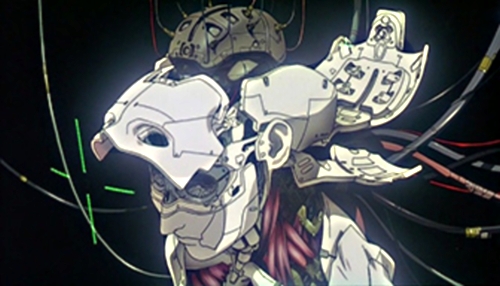
To quote a character from wonderful animated film Ghost in the Shell:

"What we see now is like a dim image in a mirror. Then we shall see face to face..."


In short, we meet with each wearing masks, and over the net, we see dim images of ourselves and those we meet - impressions of people, rather than actual people, and through that interaction, we come to know each other as they really are...