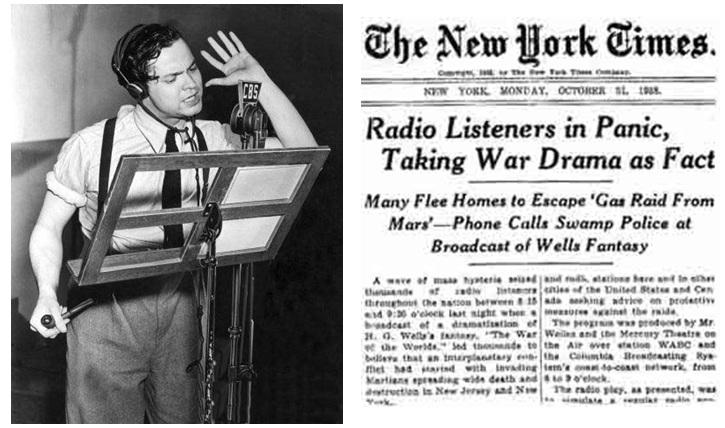
My brother brought this up in a conversation we were having a few nights ago, and then he asked me...
"What if Invasion of the Body Snatchers was read by Orson Welles over the radio in 1938 instead of War of the Worlds?"
The answer we both came up with:
"People would be shooting people instead of water towers..."
Bummer.
But seriously, what does that tell us about the impact that media has on people's perceptions of reality? They believed it because it was on the radio... then people believed it because they saw it in a movie... then because they saw it on TV... and now they believe it because they saw it on the Internet.
I find that the willingness of many people to accept what they're shown through popular media as "Truth" is vaguely alarming. On the whole, this blind faith is fairly harmless when taken in the context of entertainment - a well-staged joke or false event to make long hours in front of a computer pass by a little more smoothly... but sometimes these things can mutate into something misunderstood as "Truth" and can actually cause harm.
Gamers often catch the brunt of things like this, wherein videos meant to be entertaining jokes like Angry German Kid, WoW Freakout - Password Change, Greatest Freakout Ever, Greatest Freakout Ever 2 , etc. which are meant to be no more than amusing little videos based on gamer-sterotypes, are taken as genuine, serious recordings that "prove" the dangers of video game addiction. Video games, like radio, film and TV before them are often blamed for the ills of society - parents aren't failing to raise their children, it's the fault of those evil video games (that we bought them...).
Now, this isn't to say that all society's problems are caused by neglectful parents, nor are they caused by video games (or media of any form), but there is a trend that functions on a massive scale which suggests that while the general populace are not "mindlessly passive consumers", they can be convinced of an artifact's validity so long as it's presented in a format that supports it.
Films like Wag the Dog make commentary of that kind - in illustrating how easy it might be (or has been, looking at global history over the last ten years or so) for a clever few in power to generate an entire war without ever firing a shot or dropping a bomb. The public believes because they were shown events through the correct channels, or enough channels, prompting them to believe in and support a war that didn't exist.
That film, and others like it, suggest that the public can be made to believe because they, (or someone else) saw it happen... or at least they thought they did.

The power of the media is tremendous, and I think it might do all of us well to take more care in trying to diversify our sources of information to avoid that kind of thing in the future...

No comments:
Post a Comment