3.28.2011

arena for social change

Okay, this one should be short and fairly sweet...


In the early days, it was generally argued that video games were nothing more than a means of entertainment and one could generally be hard-pressed to argue it to the contrary.
Now, as games continue to evolve and mature as a medium, we see aspects of social commentary beginning to seep into them. One that we find is that of sexual orientation and human rights.
BioWare is one of the leading companies in the field that strive to break conventions, not only in the history of  video games, but social mainstream media.


BioWare's latest title, Dragon Age II features a variety of playable races, genders and a large variety of NPCs that are available to include in the player's team. A few of these characters are options for romance-paths of the main story, and that includes same-sex relationships.


Rather surprisingly, this caused problems in some areas of the gaming community who felt that their gaming experience was being thrown off by the inclusion of a possible (but not mandatory) homosexual relationship between their player character and an NPC.

There was an article (found here), about one such person, calling himself "Straight Male Gamer", postedon the BioWare blog for the game complaining about this issue... and royaly making a fool of himself in the process.

The lead writer for Dragon Age 2, David Gaider posted a personal response to the less than intelligent rant put forward by Straight Male Gamer on the forum in response, calmly and intelligently not only the choice of including the possibility of same-sex romances for the player, but the need to cater to all  of the gaming community, regardless of gender, sex or sexual preference.

I cheered, I'll admit, when I read about it, and despite the fact that I'm not a fan of the Dragon Age series ( I find I dislike the turn-based combat... it's too slow), I readily applaud both BioWare's ability to defend their medium as an artform capable of real-world commentary, and their willingness to do so in within the scope of a major AAA title.

This gives me hope that video games are able to support the kind of life-changing capability I hope to achieve through them myself as a would-be developer. It's too much to hope that I could change the world with a game, but perhaps, if the game development community continues to produce titles that incorporate and explore as many assets of humanity, society and culture as they can, perhaps that can help in making the world a little better, one save game at a time...
3.27.2011

War of theWorlds vs. Invasion of the Body Snatchers vs. Mass Media...


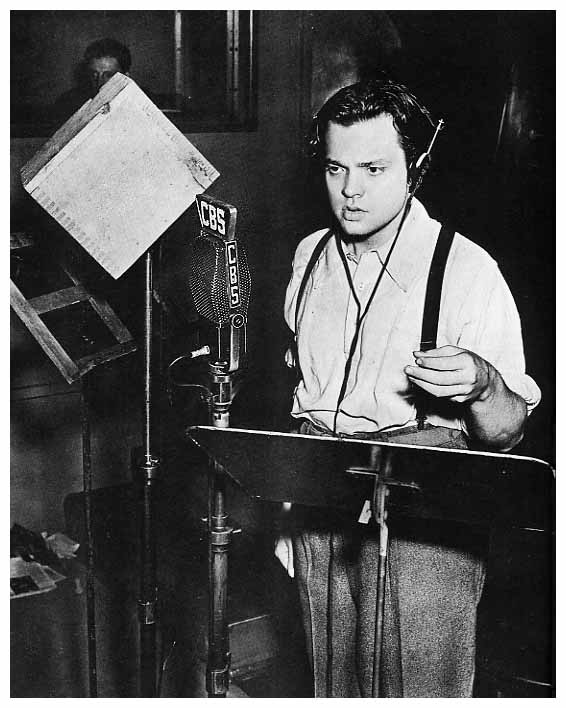
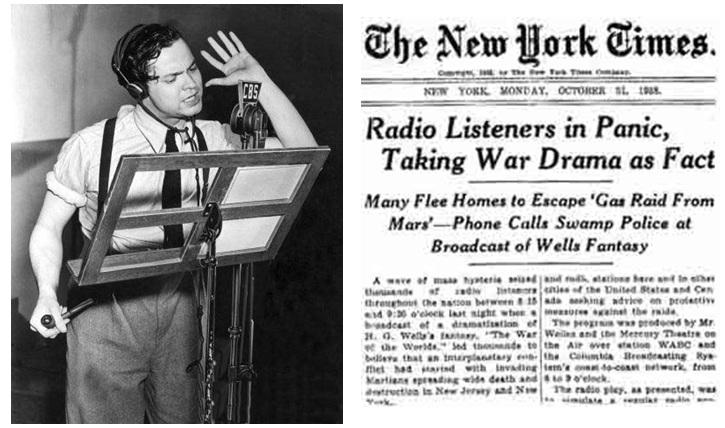
We all know the story of how  Orson Welles and others preformed a radio play of War of the Worlds - Orson Welles Broadcast in 1938, and (perhaps) inadvertently caused panic, confusion and a certain amount of chaos across a fairly large area because many people believed that the broadcast was not, in fact, theatrical, but live news coverage of an actual event. My brother told me that the same thing had occured years later in Ecuador, 1949, where a Spanish-speaking radio station mimicked Welles' performance and cooperated with a local newspaper that had published stories weeks before about UFO sitings in the area. The public believed, the public panicked, and when they realized the nature of the deception, they rioted and attacked those in the radio station and newspaper that had participated in the hoax.

My brother brought this up in a conversation we were having a few nights ago, and then he asked me...
"What if Invasion of the Body Snatchers was read by Orson Welles over the radio in 1938 instead of War of the Worlds?"
The answer we both came up with:
"People would be shooting people instead of water towers..."

Bummer.


But seriously, what does that tell us about the impact that media has on people's perceptions of reality? They believed it because it was on the radio... then people believed it because they saw it in a movie... then because they saw it on TV... and now they believe it because they saw it on the Internet.
I find that the willingness of many people to accept what they're shown through popular media as "Truth" is vaguely alarming. On the whole, this blind faith is fairly harmless when taken in the context of entertainment - a well-staged joke or false event to make long hours in front of a computer pass by a little more smoothly... but sometimes these things can mutate into something misunderstood as "Truth" and can actually cause harm.
Gamers often catch the brunt of things like this, wherein videos meant to be entertaining jokes like Angry German Kid, WoW Freakout - Password Change, Greatest Freakout EverGreatest Freakout Ever 2 , etc. which are meant to be no more than amusing little videos based on gamer-sterotypes, are taken as genuine, serious recordings that "prove" the dangers of video game addiction. Video games, like radio, film and TV before them are often blamed for the ills of society - parents aren't failing to raise their children, it's the fault of those evil video games (that we bought them...).
Now, this isn't to say that all society's problems are caused by neglectful parents, nor are they caused by video games (or media of any form), but there is a trend that functions on a massive scale which suggests that while the general populace are not "mindlessly passive consumers", they can be convinced of an artifact's validity so long as it's presented in a format that supports it.
Films like Wag the Dog make commentary of that kind - in illustrating how easy it might be (or has been, looking at global history over the last ten years or so) for a clever few in power to generate an entire war without ever firing a shot or dropping a bomb. The public believes because they were shown events through the correct channels, or enough channels, prompting them to believe in and support a war that didn't exist.
That film, and others like it, suggest that the public can be made to believe because they, (or someone else) saw it happen... or at least they thought they did.


The power of the media is tremendous, and I think it might do all of us well to take more care in trying to diversify our sources of information to avoid that kind of thing in the future...

3.06.2011

What's With the Remakes ?!?!?!

I'm not a film major, but I do love movies...

I've always loved stories - whatever form they took, and I spent much of my very young childhood watching movies with my parents. And having been born in the early 80's, I have a particular fondness for movies from that time period.

It is likely because of this that I view the increasing flood of remakes and long-delayed sequels to these films surging out of  Hollywood to be both vaguely disturbing and depressing at the same time.

Not that I have any particular hatred for furthering a good concept, or the re-telling/imagining of a story - I liked the 2009 Star Trek.
I really did.
Why?
Because it was in the spirit of the thing - it was not "my" Classic Star Trek - not the Captain Kirk I had watched since I could sit up on my own, but it was Star Trek in spirit, and that made it fun, and a generally good film of it's kind. Not profound, but fun, and in the spirit of a "space-cowboy" adventure with a "band together and save the world" flare thrown in for good measure.


It was alright (with me, at least), because it wasn't the Star Trek I'd grown up with - nor did it pretend to be - it was even stated, rather implicitly that what we as the audience (and the characters within the film) that they were existing in an alternate universe from the one that I had grown up with.
It was something new, it was something unique in and of itself, based on a "mythology" I had known from very early childhood, and then reconstructed to make something new and enjoyable for the 2009 audience.

But then there was Tron Legacy... which was, on the surface, something like the original, with some of the original tone... but it wasn't in the spirit of the thing.

The original Tron was a film about he speed at which information travels, corporate cut-throat politics, cyber-spirituality, a fear of the technology itself and a number of other cultural, philosophical, and technological questions that were nothing short of revolutionary in its time. These ideas could only be brushed on very lightly, however, because of the time in which the film was made.

(Painting of TRON by HenryTownsend on Deviant Art)
 
In 1982, very few people had a personal computer, let alone any real understanding of the way in which this new and exciting technology worked. Video games were still struggling to return to the home market after their messy (abet temporary) death in the mid 70's, but were seeing an increase in popularity in the form of the arcade with preteen to teenage audiences. So a film that was centered around concepts and knowledge that the average person couldn't relate to would have to rely on spectacle to remain engaging to the audience as it delivered - or at least suggested at - its underlying themes. Thusly, we see Tron also as a hallmark of "cutting edge" digital and animated special effects as well as a fore-runner in fields of thought concerning the (relatively) new field of computer technology that few had attempted to explore at the time.

Because the public was far from "technologically literate" where computers and video games were concerned, the ability of the film to really "converse" with the audience about its deeper subjects was understandably hindered, forcing us to wait until the rest of society to "catch up" to the proficiency required to really understand...


So, 28 years later, fans of the original, and those of us with an interest in video games as an art-form and viable cultural text were excited (though wary) when word came to us over the net that a new Tron was about to be released, one that seemed to have the potential and opportunity to explore those deeper subjects of cyber spirituality, the Internet as it has grown to be, and so much more.
It could, if properly executed, put Ghost in the Shell and The Matrix to shame...

But they failed - hard.


Instead of a profound, intellectual-action-packed experience was reduced to the sub-standard tripe I've increasingly taken to associating with Disney in general.

Although a number of really interesting issues ranging from computer-human "Digital DNA" structures, impartiality and freedom of information over the Internet, racial purging, questions about religion, cyber-spiritualism, etc. - they were never viewed in depth - in fact, most were only barely brushed against and would have been missed entirely by those that weren't already looking for it.

What the rest of the audience was left with was a garden-variety hyper-sexualized, male-dominated approach to technology, the Internet and "gamer-culture" that utterly failed to take advantage of those issues/subjects mentioned above.

The ideas behind cyber-spirituality, the scope and reach of the web and its impact on freedom of speech are all ideas that need to be explored, but time and time again, it seems that Hollywood and increasingly so, Disney - have displayed an almost pathological adversity to including thought-provoking content in "sci-fi" environments.

Mission Impossible, The Matrix and Inception (amongst others) have showed us that intelligent story and intense action sequences are an effective combination - not at all lacking in profit for the box offices.
So then why this pathological aversion to forwarding this trend, rather than rely only on spectacle as the primary device of modern film?

I'm sure there's a financially-viable reason for it... I refuse to believe that the majority of the populace has been reduced to mere mindless consumers of media... or that Hollywood is so utterly desperate fro writing talent that it can't find more people to write really good stories...

Perhaps we're waiting on some kind of Renaissance in Hollywood... one in which a combination of thought-provoking content will be equally as important in a film as massive explosions and strategically-placed low-angle camera shots...

I hope...