1.26.2011

Canadian Identity in Video Games...

        
                     It occured to me rather suddenly in class today that a number of the highly-acclaimed, "AAA Titles" that are made by Canadian game companies share a number of particular elements cholars in film have identified as trends in Canadain cinema...
The Road Movie
The Loss of Identity
Body Horror
Boarders

Titles like Elder Scrolls: Oblivion and Fallout: New Vegas (Bethesda), and Bioshock (Digital Extremes) are good examples of games that exhibit these trends...
Now, if youve played, or are familiar with these titles, you'll likely see where I'm going already, so bare with me (or feel free to skip ahead to the next post).Each of these titles involves a player character who we honestly know very little about. At most, we're given very, very rough details...
In Elder Scrolls: Oblivion, you're a prisoner in a cell. We're never told why.

In Fallout: New Vegas, you're a Courier who starts the game by being shot in the head (presumbly resulting in memory loss).
In Bioshock , you're a man on a plane, who had pictures of people (who may, or may not be your parents), which we are able to view briefly before the plane falls from the sky and into the ocean. You are the only survivor.

See the connections?

We'll look at Fallout: New Vegas as an example...
We begin the game with a video cutscene in which the player's character is shot in the head by a group of thugs led by a ma in a checkered suit. Upon waking, we are met with a kind but tired sort of fellow by the name of Doc Vollmer, who informs the player of how we had been discovered shot on the outskirts of the town, Goodsprings and brought there for treatment.
From here, the formation of the player's character and their ultimate destiny begins - physical appearance, gender, age, skills, physical and mental attributes are all determined by the player's decisions. And as the game progresses through seige, open desert and impending war, the player and their character discover the past that lead to the violent and near fatal events of the game's opening cinematic.
In short, Fallout: New Vegas is a game centered on the ideas we see so often in Canadian cinema:

Road Trip
Our adventure begins as a journey to New Vegas, over the course of which we, as players, learn and develop our character to suit the environment in which they exist,  evolving and "maturing" in that world until the completion of the game.

The Loss of Identity
The opening sequence of the game involves a litteral loss of identiy,  and we begin as a fully-grown adult who must begin from scratch.

Body Horror
We are constantly plagued by the problem of radiation poisoning, and the player is forced to carefully monitor what the character eats and how much to avoid reaching a state in which the character becomes ill, suffers health loss and (if desired), may cause mutations in the character's DNA that will result in them becoming like some of the hostile creatures found in the desert called Ghouls.


Boarders
A constant theme throughout the story of New Vegas, regardless of the path the player chooses, is the idea of invasion from other stronger forces. Whether it be from Cesar's Legion, the Powder Gangers, the Vipers, the NCR or any number of other groups all fighting for control over the limited resources found in the post-nuclear apocalypse Mojave Desert.
It's obvious that even in these seemingly alien and far-removed worlds, those same themes of Canadian identity (or lack thereof) prevail in even the new media of video games, but unlike film, seems able to reach out beyond Canada's borders to an international audience that receives it with open arms...

1.19.2011

The Modern Undead - Fad or a Sign of Something More?


Recently I've become aware of the sudden fascination much of the world has developed with the shambling undead - or zombies, if you prefer.

While the classical depiction of the zombie as some unlucky person under a mind-control spell (as seen in the 1932 film White Zombie, starring Bela Lugosi) has become nearly extinct, and the mystery-origin variety seen in the George A. Romero interpretation of the shambling undead is giving way to what can only be described as plague-zombies, which are by far the most popular variation than any other before.

 We see them appearing nearly everywhere now, ranging from parodies of classic literature (eg: Pride and Prejudice and Zombies), to comedic representations we see in films like Shaun of the Dead, and video games like Plants vs. Zombies. Most prolific, however, is the horrifying spectacle of zombies attacking the living.
This last representation is the one that seems most prolific. Films, TV shows and video games alike are depicting the proverbial Armageddon via hoards of the ravenous undead. Some "plagues" are caused by strange rabies-like diseases, others are the product of radiation spills, and others are simply left unexplained.
Some run, others shamble, some self-destruct if they are unable to find a victim and others are unkillable.

The only constant seems to be that regardless of age, race, sex or religion - the human race is vulnerable to this threat... humanity is corrupted and turned literally into monsters.

Does this simply mean that Zombies, like other monsters like mummies, werewolves and vampires before them are seeing their time in the lime-light?

I would argue that this trend, unlike so many before them, is a little more profound, not just because of it's over-arching popularity, but what it might mean.
Humanity is more frightening than ever now... wars are not fought between countries or nations anymore - they're fought by special-interest groups, be they religious, corporate or other. Those that could do us harm on a very profound level look like everyone else, not soldiers with rank and uniform. Combined with the fear of global illnesses like the H1N1, Swine Flu, Mad Cow Disease, HIV/AIDS, and so-on, humanity, (especially those of us living in "1st World" countries) are becoming more and more aware of how delicate and easily-destroyed our "way of life" is.
More often than not, the protagonist in these stories often wakes up suddenly (from surgery or a peaceful sleep at home), to find themselves surrounded by the bodies of those people they could trust, torn and twisted into creatures that mean them harm.
The "fear of the Other" we saw in much of the monster movies that came out previously has been superseded by the "fear of Ourselves" - the idea of "We" as a culture, ethnic group, religion, race, sex, gender, etc. are all rendered pointless when everyone and anyone could become "the Enemy" - we become isolated by the otherness of our friends, family, neighbours, and culture.

Now, this idea of alienation isn't just a result of North America's sudden introduction to global terrorism (something the rest of the world has been dealing with for a long time), but I think perhaps it might be a combination of many factors.

One, may be due to the idea of technology as a binding factor between individuals - no matter where one is in North American society, it's expected now that you must be "plugged in", whether it be through your phone, your net-book or your computer - everyone is expected to be available for contact all the time.

This connectedness, combined with the idea that society as a whole is almost desperate to claim individuality, while sharing and exposing the most personal aspects of ourselves and of others who have their information posted on the pseudo-anonymous arena of the Internet.
One recent film with a seemingly uninteresting premise that yeilds surprising and praise-worthy results approaches this idea of "climbing inside" of others, searching for something we ourselves might want or be lacking. The Canadian-made horror Pontypool is an atypical zombie movie in which a handful of people are trapped in a small Ontario town's radio station...
That's what it appears to be at any rate.
In truth, Pontypool is actually a film about the issues mentioned above - communication becomes an overpowering force that overwhelms basic humanity, reducing them to rabid consumers of communication media. The "Infection" itself spreads in the form of a metaphorical zombie plague spread by the spoken word - a factor heightened not only by the location and occupation of our main characters, but the fact that the film may also double as a radio-play.
Mass communication, in a more basic and fundamental form than the Internet serves as the literal petri dish to spawn humanity's undoing.

Others seem to embrace the idea of "zombification"as something like a second Halloween with a specific undead-theme (no rhyme intended!).
The practice of the "Zombie Walk" is growing in popularity, seeing hundreds of "zombie fans" collecting in the streets dressed as the living dead, shuffling, moaning and generally making the street unfit for the living for a little while... though unlike their mythological counter-parts it's considered bad-form to break things or attack people in or out of buildings (moaning, demanding brains and pulling grotesque faces is encouraged, however).

Others revel in the idea of a "Zombie Apocalypse", in which most of humanity are turned into the ravening undead, and a chosen few struggle to fight and survive against an army of billions. Some choose to take this event in a comical sense, seen in films like Shaun of the Dead, Zombieland and games like Dead Rising . Others approach the fictional event in a more serious, macabre way - seen in films like Dawn of the Dead, . We also see it in games like the Resident Evil series, series and the Left 4 Dead and Left 4 Dead 2.
Especially in gamer-culture, references to the "Zombie Apocalypse" are abundant, and many have jokingly engaged in planing emergency procedures in the case of such an event.
Example here: link
Book franchises too take advantage of this jokingly studied "home defense" approach, like the authors of The Zombie Survival Guide, The Zombie Combat Manual, and World War Z.

In short, it seems that our fascination with the undead doesn't seem to be waning any time soon, and I wonder - being the vaguely paranoid sort... With 2012 coming up... a date sometimes viewed as the proverbial End of Days ... Are these zombies we see depicted in popular media metaphors for some impending doom?
O.o

1.07.2011

Cyber Identity


Cyber identity... I would argue this idea is  not a new one, though it still seems to be a subject of popular debate by academics and non-academics alike.

Who are we when we're online?
I've heard some people argue that they're completely different people when they're online, some say that they're more themselves, some say they're more aggressive, more polite, more outgoing, more reclusive.
There seems to be a divide present, in the way that people generally view technology and how we behave, how we're represented and how we understand our own identity and the identity of those around us... one that suggests that there is a divide between the perception of self in respect to the first-life self and the second-life self.
I find this a little strange... It seems as if the general populace of the world has suddenly become aware of the idea that the notion of "I" is subject to change at any given moment, depending on mood, circumstances and so on.
I am me. But I am me as I am at the moment. Who I am may change at any moment.
Philosophers, psychologists and the general populace have been talking about the "masks" we all wear -  how we behave differently at home than we do when we're sitting in class, which are different from how we behave when we're with our friends. We understand these different "states of self" with little difficulty, because we place importance on the notion of the physical, the real, and the immediacy of our actions in affecting change in our environment.
Our behaviors are altered by out physical surroundings.
But strangely, many people seem to separate our modes of behavior over the internet with other users as being something different, something separate from and functioning on a completely different set of rules than those that we impose on ourselves in our "first life".
Why, I ask, is there such a separation - such a tenancy to diminish one's actions and the repercussions of those actions in the virtual environment of the internet.
Is there really any difference between the relevance of our behavior in first life and the second?
Does being cruel or unpleasant on the net mean nothing simply because the other person can't see you? Or will never know your real name, or where you are?
As an IASC student, and someone who spends a great deal of time on the net, I've taken up a philosphy as follows:
The concept of "I" is transiant.
Therefore, "I" am capable of change, my physical self is a part of how I perceive the world around me, and associate myself with both my physical and psychological perception.
Therefore, when I'm on the net, communicating with other people, I'm not quite ethereal, but the idea that my conscious self can travel beyond the limits of my physical reach is a pseudo cyber-spiritual state of being.
I am a part of the Internet, and it's a part of me. I reach out over the net and communicate with others I may never see, reading and seeing images that are entirely digital, entirely made of energy.

Spacey, isn't it?


So then, how do we determine what the "self" is?

Consciousness is my preferred (and drastically simplified answer).

This idea of self being a malleable, transient state of being,  allows for the idea of connectivity on an almost omnipresent level - something like the more paranormal form of "consciousness to consciousness" communication... a "one with the universe" state (in a way).

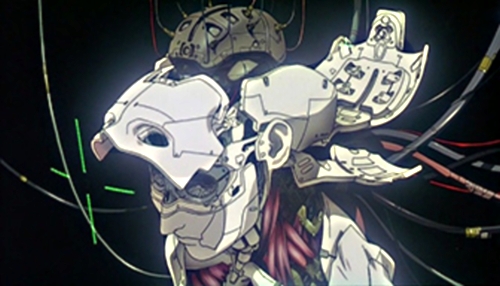
To quote a character from wonderful animated film Ghost in the Shell:

"What we see now is like a dim image in a mirror. Then we shall see face to face..."


In short, we meet with each wearing masks, and over the net, we see dim images of ourselves and those we meet - impressions of people, rather than actual people, and through that interaction, we come to know each other as they really are...