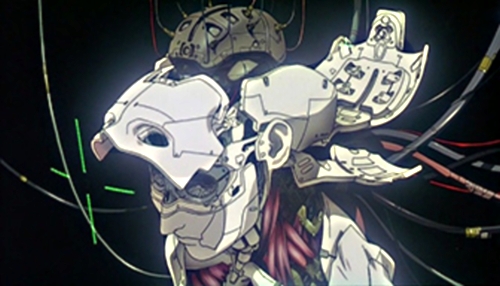
Cyber identity... I would argue this idea is not a new one, though it still seems to be a subject of popular debate by academics and non-academics alike.
Who are we when we're online?
I've heard some people argue that they're completely different people when they're online, some say that they're more themselves, some say they're more aggressive, more polite, more outgoing, more reclusive.
There seems to be a divide present, in the way that people generally view technology and how we behave, how we're represented and how we understand our own identity and the identity of those around us... one that suggests that there is a divide between the perception of self in respect to the first-life self and the second-life self.

I am me. But I am me as I am at the moment. Who I am may change at any moment.
Philosophers, psychologists and the general populace have been talking about the "masks" we all wear - how we behave differently at home than we do when we're sitting in class, which are different from how we behave when we're with our friends. We understand these different "states of self" with little difficulty, because we place importance on the notion of the physical, the real, and the immediacy of our actions in affecting change in our environment.
Our behaviors are altered by out physical surroundings.
But strangely, many people seem to separate our modes of behavior over the internet with other users as being something different, something separate from and functioning on a completely different set of rules than those that we impose on ourselves in our "first life".
Why, I ask, is there such a separation - such a tenancy to diminish one's actions and the repercussions of those actions in the virtual environment of the internet.
Is there really any difference between the relevance of our behavior in first life and the second?
Does being cruel or unpleasant on the net mean nothing simply because the other person can't see you? Or will never know your real name, or where you are?
As an IASC student, and someone who spends a great deal of time on the net, I've taken up a philosphy as follows:
The concept of "I" is transiant.
Therefore, "I" am capable of change, my physical self is a part of how I perceive the world around me, and associate myself with both my physical and psychological perception.
Therefore, when I'm on the net, communicating with other people, I'm not quite ethereal, but the idea that my conscious self can travel beyond the limits of my physical reach is a pseudo cyber-spiritual state of being.
I am a part of the Internet, and it's a part of me. I reach out over the net and communicate with others I may never see, reading and seeing images that are entirely digital, entirely made of energy.
Spacey, isn't it?

So then, how do we determine what the "self" is?
Consciousness is my preferred (and drastically simplified answer).
This idea of self being a malleable, transient state of being, allows for the idea of connectivity on an almost omnipresent level - something like the more paranormal form of "consciousness to consciousness" communication... a "one with the universe" state (in a way).
To quote a character from wonderful animated film Ghost in the Shell:
"What we see now is like a dim image in a mirror. Then we shall see face to face..."
In short, we meet with each wearing masks, and over the net, we see dim images of ourselves and those we meet - impressions of people, rather than actual people, and through that interaction, we come to know each other as they really are...


No comments:
Post a Comment